Research Training Program
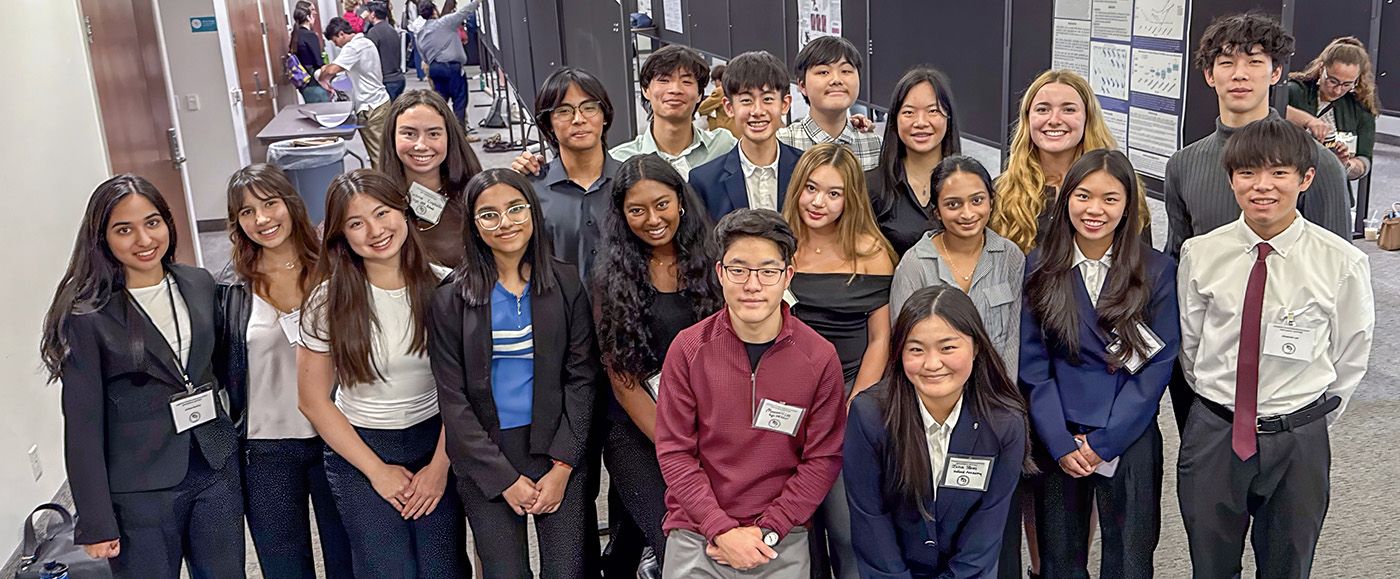
The Southern California Academy of Sciences Research Training Program (RTP) is an initiative established to encourage enthusiastic STEM high-school students to conduct original research in a professional laboratory setting under the guidance of a working scientist [see program overview]
-
"Since starting RTP, I've gained incredibly valuable knowledge on writing a paper and preparing a poster to present my work, skills that I intend to carry with me in future endeavors. The meetings hosted by RTP have also been some of my favorite memories in recent times, and getting to discuss and share ideas with both seasoned scientists and fellow high school students has been a greatly rewarding experience." - Justin L.
"I am very grateful for the opportunity to learn from academics and research professionals to pursue my goal of becoming a biological researcher." - Madison S.
Who can participate
The RTP provides an opportunity for students who are attending high school (grades 9-12 in the 2026-27 academic year) in southern California to meaningfully engage in the scientific process over the course of their academic year. The RTP Committee will accept up to 25 students from schools throughout the region. While most applicants will come from Southern California, we recognize that SCAS is the only California member of the National Association of Academies of Science (NAAS), and we are therefore happy to consider students from throughout the entire state. Previous research experience is helpful but not required. We operate on curiosity and a sense of wonder.
What is required for the online application?
Applications must be submitted by June 30, 2026. Each participant must perform an original project in which they have direct involvement with experimental design and the collection and analysis of data that help to address a particular research question. Additionally, each of the students must perform the work with the sponsorship of a research mentor.
Applicants will need to:
- Provide a letter of recommendation from their high-school science instructor or their research mentor.
- Outline a prospective project, methodology, a description of the research setting, and the project significance.
- Identify the mentor who will be guiding the research.
Who can serve as a mentor?
The mentor must be an individual with a doctoral degree in the sciences who is actively performing research in a professional setting in any area(s) of science. The mentor can be a professor at a local college or university, a curator at a museum or aquarium, a research scientist at a clinic or hospital, or someone working in industry. Students can work with graduate students, collections managers or other qualified staff, as long as their scientific supervisor serves as the “mentor of record”. While SCAS has strong historical leanings toward natural history, investigations in all areas of science are encouraged [see past projects].
The RTP Committee can assist with the process of finding a research mentor, but it cannot guarantee placement. Applicants who have already developed a relationship and agreement with a working scientist will be given a higher priority in the review process. Hence, our recommendation is that students seek this connection early.
What will the student be required to do throughout the Program?
Each student will be expected to engage in their chosen research project on a regular basis throughout the academic year. Over the course of the Program, each student will be required to:- Submit 4 brief (300-word) progress reports to the RTP Committee Dates of submission: Oct 15, Dec 15, Jan 15, Feb 15.
- Attend at least 3 of the initial 4 RTP-Committee-hosted workshops outlined below.
- Prepare a written manuscript for judging, the abstract of which is published in the Southern California Academy of Sciences meeting program.
- Present research via a poster at the Annual Meeting of SCAS at Pomona College in May, 2027.
(Note that this will be held on a Saturday, and that study for AP exams will not be regarded as a valid excuse.)
What are the important RTP event dates?
While many students might already be tackling projects in the summertime, the RTP formally begins at the end of July 2026 when applicants are informed of admission to the Program. Students are expected to remain in regular contact with their research mentors throughout the duration of the project, though the extent of guidance required will vary. Additionally, and importantly, participants must commit to at least three of the four workshops throughout the academic year where we will meet as a group. These workshops are hosted by the RTP Committee, and dates are listed below. Note that attending the SCAS Annual Meeting is mandatory. This meeting serves as a 5th time in the year where all RTP students will present their research.
-
Meeting 1: Saturday, September 19, 2026: 9:30a.m.-1p.m.
Natural History Museum of Los Angeles County
Agenda: Introductions, program structure, guidelines and expectations
Meeting 2: Saturday, November 14, 2026: 9:30a.m. - 1p.m. Cabrillo Marine Aquarium Agenda: Nature of the scientific process, breadth of science, statistical approaches
Meeting 3: Saturday, March 13, 2027: 9:30a.m. - 1p.m. University of California Agenda: Presentations by three to four professionals in different areas of science; undergraduate and/or graduate student panel: high-school students participate in an informal discussion with undergraduate and graduate research students.
Meeting 4: April 17, 2027: 9:30a.m. - 1p.m. Natural History Museum of Los Angeles County Agenda: Workshop on the presentation of findings via oral papers and posters
Meeting 5: May 08, 2027 (tentative): Presentation of Research at Poster Session Southern California Academy of Sciences Annual Meeting, Pomona College Agenda: Formal student-led presentation of results at the poster session (as well as optional attendance at talks)
What are the rewards of participation in the RTP?
The rewards of participation are many!- Students participate in individualized research opportunities with an expert mentor during the academic year, where projects are open to all disciplines of science and engineering.
- Students learn how to conduct research through practical, hands-on experiences.
- Students learn about current research from professional scientists, and students are able to meet and discuss science (and college) with undergraduate and graduate students.
- Students meet other participants from throughout southern California, ones with similar science leanings.
- Students gain experience communicating scientific findings, as the Program includes workshops on the preparation of scientific posters and oral presentations, and as they present their research at the SCAS annual meeting alongside college students and professional scientists!
- Students visit professional laboratory facilities as well as one or more public aquaria and/or museums.
- Students have their abstracts published in annual meeting program and in the Southern California Academy of Sciences Bulletin.
- Students bring skills from their classroom lessons to the RTP, and they bring the learnings from their RTP experience back to the classroom, and/or their next steps in college.
- Students can include descriptions of their experience as something genuine and enriching that might just help with college admissions.
- Students, as a minor benefit, receive some SCAS merch, and the opportunity to compete in the design of an RTP t-shirt.
- Students compete to be a student delegate to the American Junior Academy of Science (AJAS) at the American Association for the Advancement of Science (AAAS), February 2028.